
 English
  Polish
  Czech
Czech  German
  Spanish
  Italian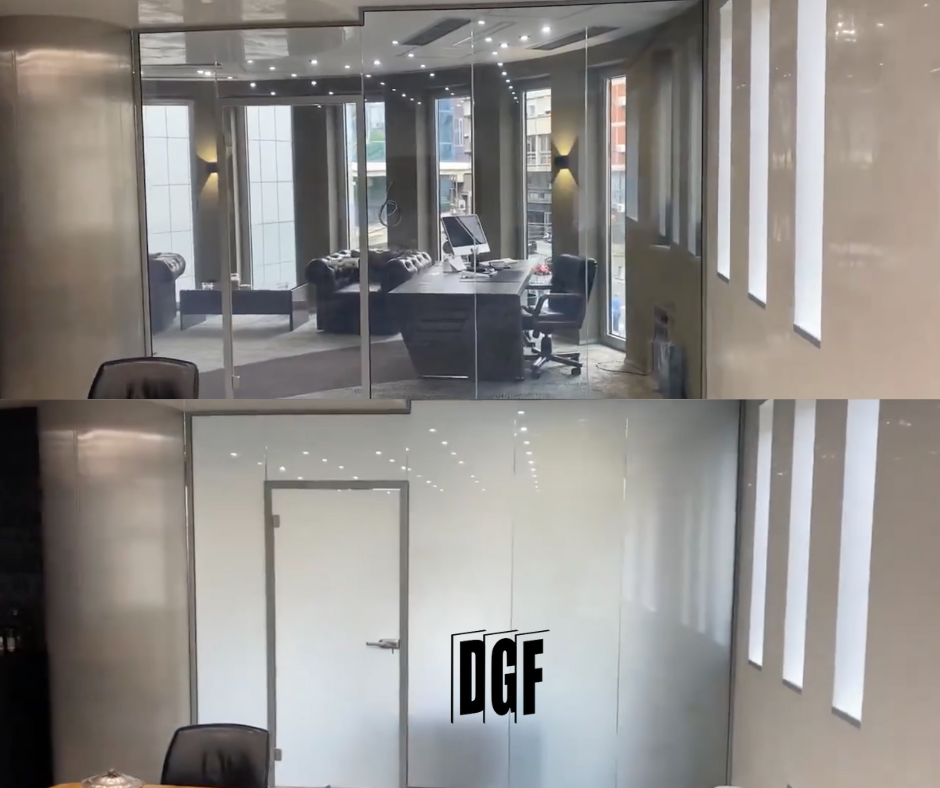
The same term “PDLC glass” may describe different build-ups, thicknesses, sizes, colours and layer arrangements. Optical performance also depends on viewing angle, light, temperature and area. Technical data therefore belongs with a drawing and application description.
A project is not about finding the largest number in a table. It is about achieving the required view, privacy and operation in the real interior, with safe power and service access. The map below shows what should be checked before the solution enters a specification.
1. Optics: clarity, light transmission and haze are not synonyms
Clarity describes whether an image can be recognised through the glass. Light transmission describes how much light passes through the build-up. Haze measures scattered light and affects the slight veil visible in the clear state. High transmission does not necessarily mean an image identical to ordinary glass.
The frosted state obscures recognisable views while still transmitting diffused light. Privacy must be assessed from real viewing directions, including at night and under strong backlighting. A measurable criterion should define distance, light and observation point.
2. Electrical: default state, voltage and power consumption
A typical DGF configuration is frosted without power and clear when powered. This affects failure scenarios, room requirements and use. Each project must approve the power supply, circuit count, cable sizing and routes in accordance with the specific system documentation.
Power per square metre must be multiplied by active area and related to hours in the clear state. It does not describe total building or control-device consumption. With many panes, channel load, spare capacity and access to diagnostic components also matter.
| Parameter | What it describes | Design decision |
|---|---|---|
| Unpowered state | Active-layer behaviour | Privacy and failure scenario |
| System voltage | Pane and power-supply requirement | Device and circuit selection |
| Power per m² | Active-area load | Power and channel schedule |
| Channel count | Independent panes or zones | Controller, scenes and spare capacity |
3. Pane build-up, size and processing are approved together
Glass type and thickness follow structure, size, support, application and project requirements. The active layer does not replace calculations, safety glass, partition testing or framing requirements. DGF confirms feasibility of its pane within the agreed solution.
Holes, cut-outs, shape, active area, zones and cable edge are defined before lamination. Finished PDLC glass cannot be freely cut, drilled or have zones moved. The manufacturing drawing is therefore more important than a general opening size.
4. Frame, edge and environment affect system durability
The frame must accommodate the actual glass build-up, tolerances, setting blocks, seals and a protected cable exit. The edge must not be compressed by improvised components or left in persistent moisture. Contact materials should follow the system documentation.
Interior partitions, windows, bathrooms, doors and healthcare spaces impose different requirements. Temperature, moisture, solar exposure, cleaning, movement and service access must be described before product approval. No single universal sheet answers every location.
5. A specification should define result, scope and acceptance
A sound clause does not end with “smart glass”. It lists the delivery: pane, active area, cables, power supplies, controllers, switches, transport, installation, connection, configuration and documentation. Responsibility is assigned for every element.
Handover covers both states, views from agreed positions, control labelling, zone operation, power-loss behaviour, edge finish and service access. A parameter that cannot be checked in the finished space or tied to documentation is not a sound acceptance criterion.
In practice: For an initial review, send DGF a plan or photo, indicative dimensions, partition type, intended frame, location, controls and privacy requirement. We will identify data that can be confirmed and those dependent on final configuration.