
 German
  Polish
  English
  Czech
Czech  Spanish
  Italian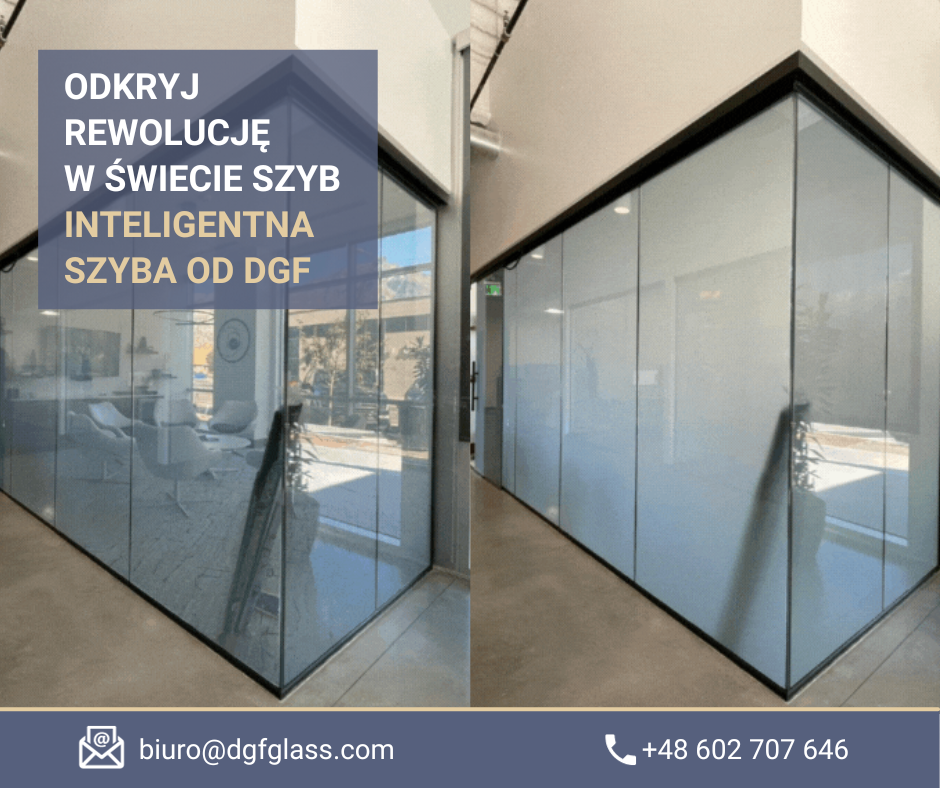
In everyday language, “smart glass”, “liquid-crystal glass”, “LCD glass” and “switchable glass” are often used interchangeably. They do not always describe the same construction. PDLC can be laminated as an active layer between glass panes or supplied as film applied to an existing surface.
DGF designs laminated glass solutions in which dimensions, shape, cable exit and any zoning are part of manufacture. The technology should therefore be considered together with the finished partition, not as an abstract film with one universal set of figures.
1. What sits inside an active pane?
The active PDLC film contains liquid crystals dispersed in a polymer layer between transparent conductive layers. In a laminated solution it is encapsulated between glass and suitable interlayers. The finished pane is a multilayer product engineered for a specific application.
Base glass, thickness, processing, interlayers and glazing method affect finished-element performance. PDLC alone does not confirm safety, acoustics, thermal insulation or resistance of the complete partition; these requirements must be specified and verified separately.
- base glass and laminating interlayers
- active PDLC layer with transparent electrodes
- electrical connection at the specified edge
- inactive perimeter resulting from product construction
2. What happens in the OFF and ON states?
In the OFF state liquid crystals are randomly oriented. Light passing through the layer is scattered, so the image beyond loses definition and the surface appears frosted. Diffused light still passes and strong backlighting can reveal shadows.
In the ON state the electrical field aligns the crystals and reduces scattering. The pane becomes clear but retains haze affected by material, area, viewing angle and lighting. A large wall in a bright corridor can look different from a small tabletop sample.
In practice: Visual privacy should be assessed in the actual lighting layout and viewing distance. “Opaque” should not automatically be interpreted as no light, no shadows or blackout.
3. PDLC film and laminated glass—the same principle, different products
With applied film, the active layer is installed on the accessible face of existing glass. This can reduce building work but requires assessment of substrate, cleanliness, edges, wiring and operating conditions. The finish remains constrained by existing glazing geometry.
In laminated glass the active layer is protected within the finished pane. Dimensions, processing and connection are fixed before manufacture, but the result can be integrated more cleanly with framing and a new partition. This is not a good-versus-bad choice; each route suits a different project stage and scope.
| Area | Laminated glass | Applied film |
|---|---|---|
| Project stage | New pane engineered before manufacture | Upgrade of existing glass |
| Active layer | Encapsulated in laminate | On the accessible face |
| Dimensions | Approved before manufacture | Fitted to the existing surface |
| Detail | Coordinated with the new frame | Dependent on existing edges and access |
4. PDLC is not the same as electrochromic or SPD glass
PDLC switches rapidly between frosted and clear, primarily managing images and privacy. Electrochromic glass gradually changes tint and is more often considered for solar light and façade comfort. SPD regulates transmitted light by changing the alignment of suspended particles.
These technologies have different resting states, response times, appearance, controls and design purposes. Performance from one should not be assigned to another, and PDLC should not be described automatically as solar-tinting glass. Define whether the project is managing views, glare, solar energy or several separate requirements.
5. Which properties must be confirmed for the specified pane?
There is no universal set of figures for every PDLC glass. Dimensions, operating voltage, power consumption, light transmission, haze, temperature range and laminate build-up vary between systems. Documentation must refer to the product and configuration specified for the project.
For the complete partition, impact safety, acoustics, thermal insulation, solar control, fire and structural requirements are specified separately. The active layer can be part of such a build-up but does not replace tests, calculations or declarations for the appropriate product.
- minimum and maximum size for the chosen configuration
- pane build-up, weight and tolerances
- power-off state and power-supply requirements
- light transmission and haze in both states
- installation conditions, edge-contact materials and temperature range
6. How to assess a sample and video evidence
View a sample in both states, from close range and normal user distance, against light and dark backgrounds. Check it relative to windows and artificial lighting because haze and shadows depend strongly on contrast and light direction.
Video shows switching behaviour, but camera exposure changes automatically and does not reproduce human vision exactly. Project footage is valuable evidence, yet final appearance should be assessed for the size, lighting and viewing conditions of the specific project.